His second mistake was putting his hand against her chest to stop her from boarding.
And his third mistake, the one that would eventually destroy everything he had spent thirty-two years building, was assuming the quiet woman standing in front of him had no power to challenge his decision.
It was 3:42 on a beautiful autumn afternoon at John F. Kennedy International Airport in New York.
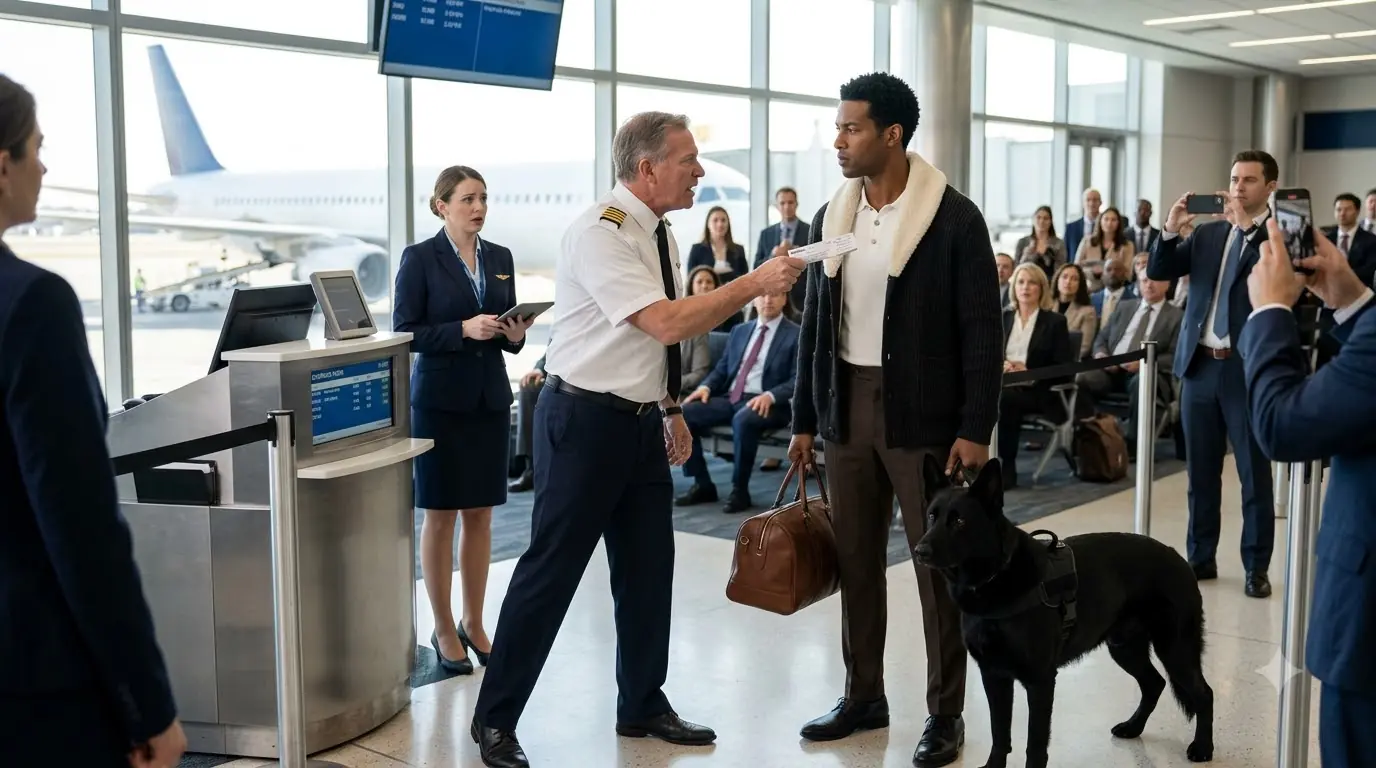
Sunlight poured through the enormous terminal windows, illuminating the polished floors, the glass boarding doors, and the rows of expensive leather seats surrounding Gate B18.
Beyond the windows, a commercial passenger aircraft stood connected to the jet bridge.
Its white fuselage gleamed beneath the afternoon sky.
A dark-blue emblem curved across its tail.
The name of the airline appeared beside the forward cabin windows.
Horizon Crest Airways.
Flight 218 was scheduled to depart for Seattle.
The aircraft was almost ready.
Catering had been completed. Baggage handlers were loading the final containers. The flight attendants had finished their preliminary cabin checks, and passengers were gathering around the priority boarding lane.
Everything should have been routine.
Then the captain noticed the woman.
She was thirty-five years old, Black American, remarkably attractive, with warm medium-brown skin, short thick natural black curls, expressive dark-brown eyes, high cheekbones, and a composed face that made her look younger than her position suggested.
She wore an exceptionally elegant charcoal-black textured wool cardigan with a thick cream-white shearling collar, a crisp white buttoned polo shirt, tailored chocolate-brown trousers, and polished black leather shoes.
The outfit was expensive without being ostentatious.
A structured brown leather travel bag rested beside her right leg.
In her left hand, she carried a smartphone and a burgundy passport holder containing her boarding documents.
Beside her stood a magnificent black German Shepherd.